
The Best Exercises to Fix a Painful, Impinged Shoulder
An orthopaedic surgeon explains the posture and shoulder-blade retraining that settles subacromial pain — and why, for this problem, exercise works as well as an operation.
By Dr. Christian Veillette, as told for patients and families
“It catches when I lift my arm, and it kills me to reach up to a shelf or fasten a seatbelt.” That painful arc, somewhere between shoulder height and overhead, is one of the most common complaints I see in clinic, and it usually has a name: subacromial pain syndrome, still widely known as shoulder impingement. It describes pain arising from the crowded space beneath the acromion — the bony roof of the shoulder — where the rotator cuff tendons and a small lubricating sac, the bursa, can become irritated when you raise the arm.
For years the explanation was purely mechanical: a bony spur was “pinching” the tendon, and the answer was to shave the bone away with keyhole surgery. That operation, subacromial decompression, became one of the most common in orthopaedics. Then two landmark placebo-controlled trials did something rare and important — they compared real decompression against a pretend operation, and found no meaningful difference. It turns out that shaving the bone was not what made people better. What makes people better, reliably, is retraining how the shoulder moves.
That is the message I most want you to take from this article, because it is genuinely liberating: for the great majority of impinged shoulders, exercise works at least as well as surgery, and it is the treatment I recommend first, almost every time. The pain is far less about a fixed, structural pinch than about how the shoulder blade and rotator cuff are coordinating — or failing to coordinate — as you lift the arm. Fix the mechanics, and the space opens up on its own.
Here is why the routine below looks the way it does. The shoulder blade, the scapula, is the moving platform the whole arm works from, and it depends on a team of muscles to tilt and rotate it out of the way as you reach up. When those muscles are weak, or posture is rounded and slumped, the platform stays flat, the space stays tight, and the tendon gets irritated — the painful arc. So this programme trains two things above all: the shoulder-blade muscles that clear the space, and the rotator cuff that centres the ball in the socket. Posture and control matter more here than raw strength.

Landmark Clinical Trials: Placebo-controlled surgical trials (CSAW and FIMPACT) conclusively proved that arthroscopic subacromial decompression surgery offers no clinically significant benefit over non-operative care or sham arthroscopy. Active scapular stabilization and rotator cuff retraining is the definitive, evidence-based gold standard.
Your Routine at a Glance
Posture, control, and coordination matter far more than heavy resistance.
Strengthening Frequency
3 to 4 days / week (non-consecutive)
Postural & Stretches
Daily (throughout the day)
Target Volume
2–3 sets of 10–15 reps (5s holds)
Timeline to Result
6 to 12 weeks for lasting relief
Before You Start: Essential Impingement Rules
- Learn to set the shoulder blade first: Roll the shoulders back and down, without shrugging, and maintain that “set” position through every exercise. This is the foundation of the entire program.
- Stay below shoulder height: Early on, work strictly in the pain-free range below 90° of elevation. Do not raise your hand above shoulder height while the bursa is irritable.
- Quality beats quantity: Mild soreness that fades is normal; sharp catching pain in the arc means stop, lower your arm, and reset your scapular posture.
- Seek advice if weak: Contact your physician if the arm becomes suddenly weak, or if nighttime pain is severe and unrelenting.
7 Exercises for Subacromial Impingement

Scapular Setting
- Sit or stand tall, arms relaxed at your sides, head and neck completely easy.
- Gently draw your shoulder blades down and back, as if sliding them into your back pockets — without shrugging up towards your ears.
- Hold for about 5 seconds, feeling the muscles between and below the shoulder blades engage, then relax.

Scapular Retraction Rows
- Hold a light resistance band in both hands out in front of you at waist height, elbows slightly bent.
- Setting the shoulder blades down and back, draw your elbows backward and squeeze the shoulder blades together.
- Hold for 3 to 5 seconds, then return slowly under control. Keep the shoulders down, not shrugged.

Isometric Rotations
- Stand beside a wall or door frame, elbow bent to 90 degrees and tucked at your side.
- For external rotation, press the back of your wrist gently outward into the wall and hold for 5 to 10 seconds. For internal rotation, turn and press the palm into the wall.
- Push to only about 40 to 50 per cent effort — steady muscular activation without sharp pain, with zero joint movement.

Resistance-Band External Rotation
- Anchor a light band at waist height. Stand side-on, holding it in the affected hand, elbow bent and tucked at your side, a rolled towel under the elbow.
- Setting the shoulder blade first, rotate the forearm outward away from your body, then return slowly.
- Control the movement both ways — the slow return eccentric phase matters just as much as the outward pull.

Full-Can Raises (Below Shoulder Height)
- Stand with your arms at your sides, thumbs pointing up, as if holding a full can in each hand.
- Setting the shoulder blades, raise the arms forward and slightly out to the side (about 30° forward of the body), keeping thumbs up — strictly to shoulder height or below.
- Pause briefly at the top, then lower slowly. Keep the movement smooth and the shoulders down.
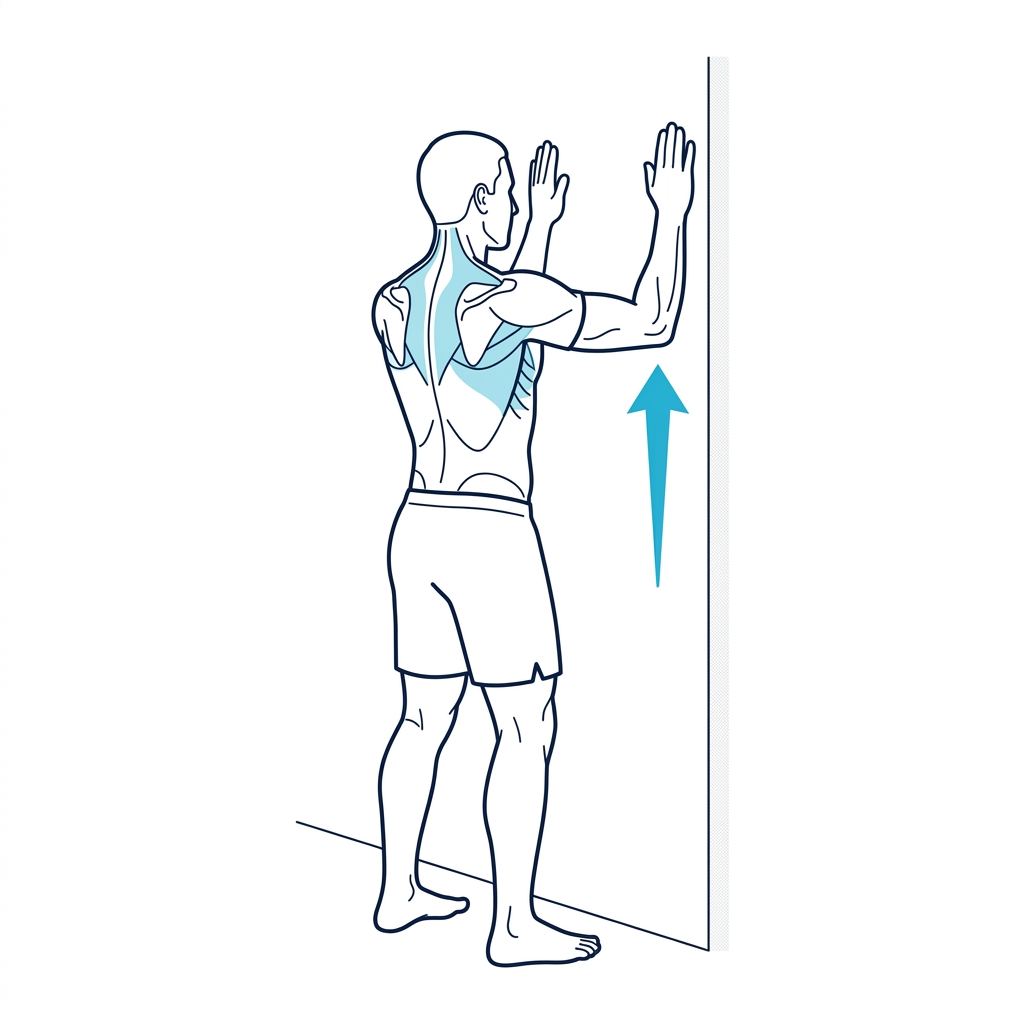
Wall Slides
- Stand facing a wall, forearms resting flat against it, elbows at chest height.
- Setting the shoulder blades, slowly slide your forearms up the wall as far as is comfortable and pain-free, keeping forearms in contact.
- Slide back down under control. The wall carries some of the arm's weight, making this much gentler than lifting freely in the air.

Serratus Wall Punches
- Stand facing a wall with the affected hand resting on it at shoulder height, elbow slightly bent.
- Keeping the elbow almost straight, gently push your hand into the wall so your shoulder blade slides forward around your ribcage (protraction), then relax it back.
- It is a subtle, controlled movement — you should feel the muscle work around the side of your ribs, never a shrug in your neck.
3 Targeted Stretches

Cross-Body Stretch
- Bring the affected arm across the front of your body at chest height.
- Use the opposite hand to support under the upper arm and gently draw it closer until you feel an easy stretch at the back of the shoulder.
- Hold for 30 seconds, keeping the shoulder relaxed and down, then release.

Doorway Pectoral Stretch
- Stand in an open doorway and rest your forearms on the frame, elbows at or below shoulder height.
- Step one foot gently through the doorway until you feel an easy stretch across the chest and the front of the shoulders.
- Hold for 30 seconds while breathing normally, then step back.

Neck and Upper-Trapezius Stretch
- Sitting tall, let the affected arm rest at your side, or gently hold the edge of your chair to anchor the shoulder down.
- Gently tilt your head to the opposite side, bringing your ear towards that shoulder, until you feel an easy stretch along the side of the neck.
- Hold for 20–30 seconds, then return slowly and repeat on the other side.
Could It Be a Rotator Cuff Tear?
Persistent impingement symptoms that fail conservative therapy often involve partial or full-thickness cuff tears.
When to See an Orthopaedic Specialist
Because exercise works so well for impingement, it is worth giving a specific program a genuine trial — 3 to 6 months of consistent effort — before considering anything more. See your doctor if your arm becomes suddenly and markedly weak or you cannot lift it, especially after a fall (signaling a possible acute tendon tear); if night pain is severe and unrelenting; or if there is no progress at all after diligent rehabilitation. In those cases, targeted subacromial injection or advanced diagnostic ultrasound/MRI can clarify whether a surgical tear is driving the symptoms.
Dr. Christian Veillette MD, MSc, FRCSC is Division Head of Orthopaedic Surgery at University Health Network (UHN), Associate Professor in the Department of Surgery at the University of Toronto, and an orthopaedic surgeon at the Sprott Department of Surgery and Schroeder Arthritis Institute, Toronto Western Hospital.
Medical Disclaimer: This article is general educational information and not a substitute for individual medical advice. Speak with your doctor or physiotherapist before starting a new exercise program.