
Total Elbow Arthroplasty (TEA) & Hemiarthroplasty
Specialized prosthetic replacement for severe rheumatoid arthritis, post-traumatic joint destruction, and non-reconstructible distal humerus fractures.
Understanding the Procedure
Severe end-stage elbow arthritis—whether from rheumatoid arthritis, post-traumatic deformity, or non-reconstructible comminuted distal humerus fractures in older adults—can severely compromise basic self-care such as eating, hygiene, and dressing.
Total Elbow Arthroplasty (TEA) utilizes linked (semi-constrained) prosthetic components to replace the damaged distal humerus and proximal ulna, connected by an articulation pin that provides inherent joint stability while allowing smooth functional flexion and extension.
Download Rehabilitation Protocol
Official post-operative physical therapy guidelines, range of motion envelopes, and milestone criteria:
Download Total Elbow Replacement Protocol (PDF) ↓3D Pre-Operative Assessment & Component Sizing
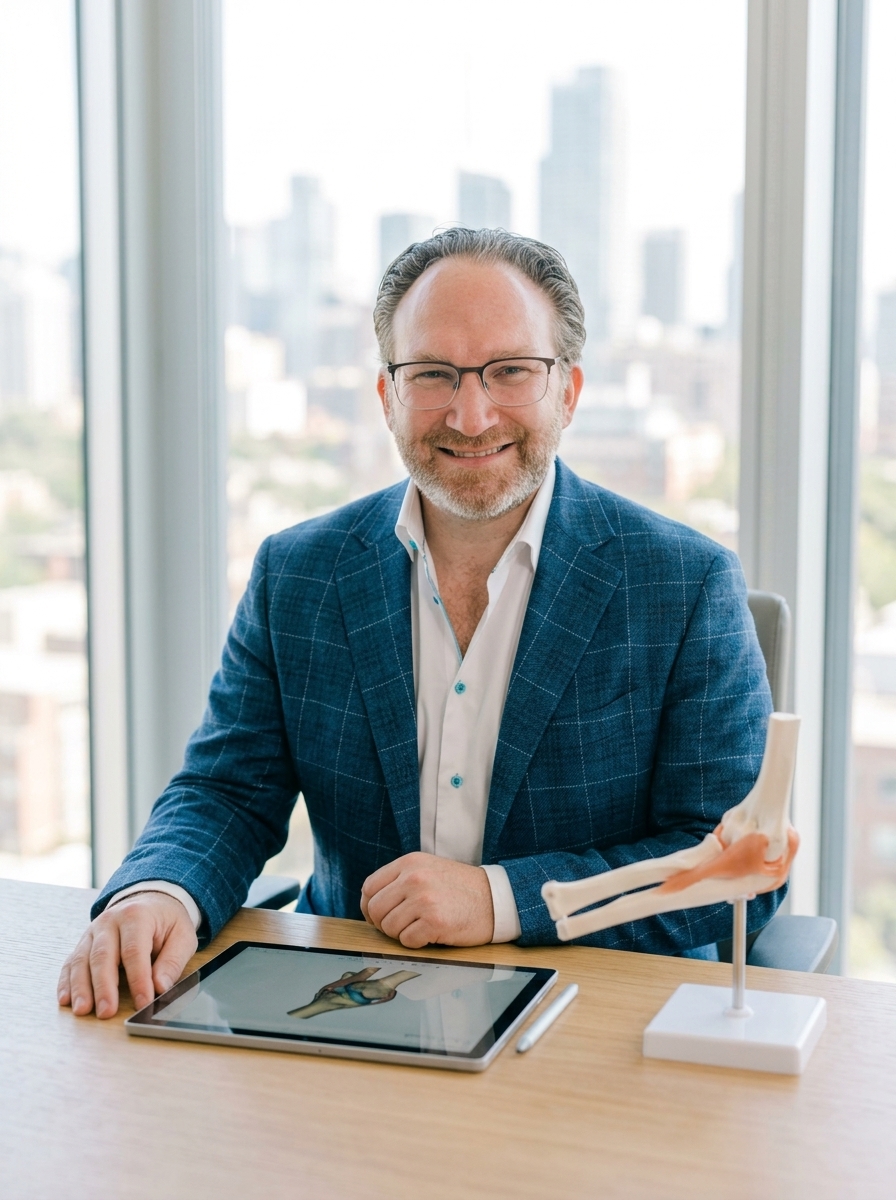
Total elbow arthroplasty requires meticulous bony canal preparation and soft-tissue balancing. As one of the few fellowship-trained shoulder and elbow specialists in Canada performing complex elbow reconstruction, Dr. Veillette combines advanced digital templating with precision surgical execution.
Pre-operative multiplanar CT imaging allows for accurate measurement of humeral and ulnar canal dimensions, anterior flange bone contact, and ulnar nerve transposition planning, ensuring stable component fixation and long-term implant longevity.
Phased Rehabilitation Milestones
Wound Healing & Splint Immobilization
Posterior plaster splint at 90°. Strict elevation. Active digit and thumb tendon glides.
Controlled Functional Motion Arc
Removable hinged brace. Active-assisted flexion and extension within 30° to 130° arc. Protect triceps repair.
Active ROM & Daily Self-Care
Wean brace. Light functional ADL activities (eating, washing face). Strictly respect weight limitations.
Long-Term Joint Preservation
Independent living with permanent adherence to lifetime 5-lb lifting precautions.
Frequently Asked Questions
Total elbow arthroplasty (replacing the damaged joint surfaces with metal and plastic implants) usually requires a 1 to 2 night hospital stay for monitoring and pain control.
The arm is immobilized in a splint for the first few days to allow the incision to heal, followed by transition to a protective brace.
Gentle range-of-motion exercises begin within the first week. Therapy focuses on restoring functional movement while strictly protecting the triceps repair.
Driving may resume at 6 weeks once off narcotics. Desk work can be resumed in 2 to 4 weeks.
High-impact sports are prohibited. You can return to light activities like putting in golf or swimming after 3 to 4 months.
Patients with a linked total elbow replacement must adhere to a permanent lifetime lifting limit of 5 lbs for a single lift and 2 lbs for repetitive tasks to prevent prosthetic loosening.
Specialized Elbow Reconstruction & Care
Don't let complex elbow conditions limit your daily function. Contact Dr. Veillette's clinic to explore evidence-based surgical solutions for restoring strength, stability, and pain-free motion.