
The Best Exercises to Strengthen a Torn or Ageing Rotator Cuff
An orthopaedic surgeon explains the graded strengthening that can settle the pain of a worn or torn cuff — and let most people avoid an operation altogether.
By Dr. Christian Veillette, as told for patients and families
Few phrases land as heavily in my clinic as “you have a rotator cuff tear.” Patients hear the word “tear” and picture something snapped, ruined and in need of urgent repair. So the first thing I do is take some of the fear out of it. Rotator cuff tears are extraordinarily common, especially as we get older, and the great majority never need surgery. In fact, many people walking around comfortably today have a cuff tear they know nothing about.
The rotator cuff is a group of four muscles and tendons that wrap around the shoulder like a cuff, centring the ball in the socket and letting you lift, reach and rotate the arm. As we age, these tendons gradually wear and their blood supply dwindles, so they tear more easily — sometimes from a specific injury, but often from nothing more than time. That is why cuff tears become steadily more common after 40, and why studies find them in roughly a quarter of people in their sixties and more than half of those in their eighties, many with no symptoms at all.
Here is the message I most want patients to hold onto, and it needs saying plainly. Exercise will not knit a torn tendon back together — that is not what it does, and any programme that promises to “heal” the tear is misleading you. What exercise does do, extremely well, is make you comfortable and functional despite the tear. By strengthening the muscles that remain and retraining the shoulder blade to do more of the work, you can take the load off the injured tendon, settle the pain, and get your arm working again. The evidence for this is strong: well over half of people with cuff tears manage successfully without ever having surgery, and only about 30 per cent ultimately need an operation.
The shoulder relies on muscle, not bone, for its stability, and the cuff works as a team with the muscles around the shoulder blade. That is why this routine deliberately trains both: the rotator cuff itself, and the scapular muscles that give it a stable base to pull against. The golden rule is endurance over brute strength, and control over heavy load — and while the cuff is irritable, keeping the arm below shoulder height and avoiding heavy overhead lifting.

Clinical Evidence: High-level randomized controlled trials confirm that structured physical therapy and progressive rotator cuff strengthening resolve pain and restore functional kinematics in 75% of degenerative rotator cuff tears, producing long-term outcomes equivalent to surgical repair in patients over 50.
Your Routine at a Glance
Consistent endurance training for stability, not a contest of brute strength.
Strengthening Frequency
3 to 4 days / week (non-consecutive)
Mobility & Stretches
Daily (little & often)
Target Volume
2–3 sets of 10 reps
Timeline to Result
6 to 12 weeks for steady gains
Before You Start: Essential Safety Rules
- Work below shoulder height: Keep the arm below shoulder level early on, and avoid heavy overhead lifting while the shoulder is irritable.
- Warm up first: A warm shower or 5–10 minutes of gentle movement loosens the shoulder. Ice for 15 minutes afterwards if sore.
- Master the basics before adding resistance: Master gentle motion and isometric holds before adding elastic bands. Progress resistance only when completely pain-free.
- Listen to the pain: Mild muscle soreness is expected; sharp pinching pain or night pain that wakes you means ease off immediately.
7 Exercises for a Torn or Ageing Cuff
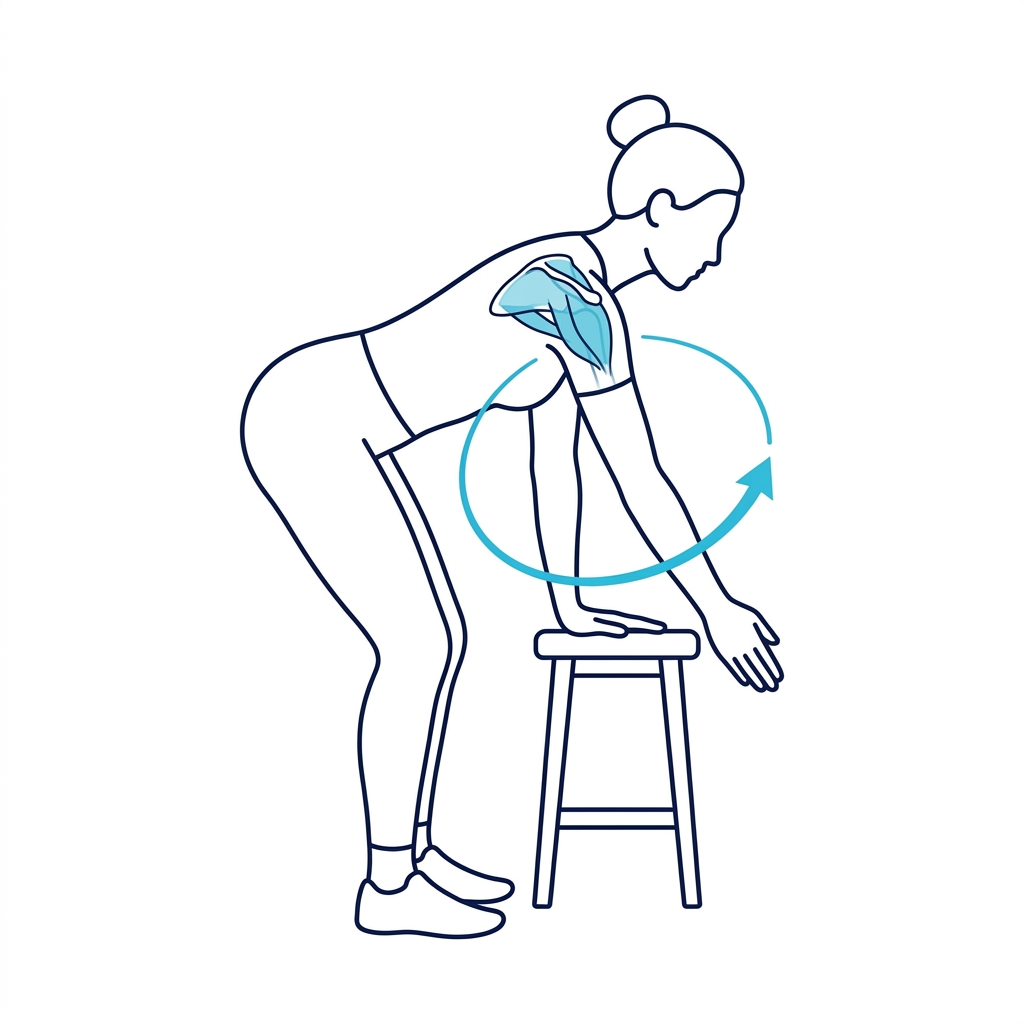
Pendulum Swings
- Lean forward and rest your good hand on a table or chair, letting the affected arm hang straight down and completely relaxed.
- Using small movements of your body, not your shoulder, let the arm swing in small circles, then forward and back, then side to side.
- Aim for about 10 repetitions in each direction, keeping the arm heavy and passive throughout.

Assisted Forward Elevation with a Stick
- Lie on your back holding a cane, broom handle or dowel in both hands, palms down, hands shoulder-width apart.
- Using the good arm to push, slowly raise the stick up and overhead until you feel a gentle stretch, stopping short of any pinch.
- Hold briefly, then lower under control. Lying down supports the arm and makes this easier than standing.

Table Slides
- Sit at a table with a folded cloth or towel under the hand of the affected arm.
- Lean your body forward and let the hand slide out across the table, reaching as far as is comfortable.
- Slide it back towards you and repeat smoothly. The table carries the weight of the arm, so the cuff barely has to work.

Isometric Rotations
- Stand beside a wall or door frame with your elbow bent to 90 degrees and tucked firmly at your side.
- For external rotation, press the back of your wrist gently outward into the wall and hold for 5 to 10 seconds. For internal rotation, turn and press your palm inward into the wall.
- Push to only about 40 to 50 per cent effort — there should be muscular effort but no sharp pain, and the arm should not move.

Resistance-Band External Rotation
- Anchor a light band at waist height in a door. Stand side-on, holding it in the affected hand, elbow bent to 90° and tucked at your side.
- Keeping your elbow pinned to your side, rotate the forearm outward away from your body, then return slowly.
- Control the movement in both directions — the slow return phase matters just as much as the outward pull.

Resistance-Band Internal Rotation
- With the band anchored at waist height, turn to face the other way so the band crosses in front of you, holding it in the affected hand.
- With the elbow tucked at your side, pull the forearm inward across your abdomen, then return slowly against the band's pull.
- Keep the elbow glued to your side so the work comes strictly from the rotator cuff, not from twisting your body.

Scapular Squeezes and Rows
- Sit or stand tall holding a light band in front of you, arms out at about waist height.
- Draw your shoulder blades down and back, as if gently squeezing a pencil between them, pulling your elbows back as you squeeze.
- Hold for 5 seconds, then release slowly. Keep the shoulders down, never shrugged up towards the ears.
3 Targeted Stretches

Cross-Body Posterior Capsule Stretch
- Bring the affected arm across the front of your chest at approximately chest height.
- Use the opposite hand to support under the upper arm and gently draw it closer to your body until you feel an easy stretch.
- Hold for 30 seconds while keeping the shoulder relaxed and down, then release slowly.

Sleeper Stretch
- Lie on your affected side with your shoulder and elbow bent to 90 degrees, upper arm in line with your shoulder.
- Using the opposite hand, gently press the affected forearm down towards the bed until you feel an easy stretch at the back of the shoulder.
- Stop at a gentle stretch — never force it — hold for 20–30 seconds, then release.

Doorway Pectoral Stretch
- Stand in an open doorway and place your forearms against the doorframe, elbows at or below shoulder height.
- Step one foot gently through the doorway until you feel an easy stretch across your chest and the front of your shoulders.
- Hold for 30 seconds while breathing normally, then step back.
Interested in Surgical Indications?
Learn how arthroscopic tendon repair is performed when conservative management does not provide sufficient relief.
When to See an Orthopaedic Specialist
Exercise is the right first step for most worn or torn cuffs, but not all of them. See your physician promptly if your arm becomes suddenly and markedly weak, if you genuinely cannot lift it or hold it up against gravity (a "drop arm"), if the weakness followed an acute fall or traumatic injury, or if night pain remains unrelenting despite diligent therapy. These features can signal an acute or large tear where earlier surgical repair yields superior outcomes, especially in active patients.
Dr. Christian Veillette MD, MSc, FRCSC is Division Head of Orthopaedic Surgery at University Health Network (UHN), Associate Professor in the Department of Surgery at the University of Toronto, and an orthopaedic surgeon at the Sprott Department of Surgery and Schroeder Arthritis Institute, Toronto Western Hospital.
Medical Disclaimer: This article is general educational information and not a substitute for individual medical advice. Speak with your doctor or physiotherapist before starting a new exercise program.