
The Best Exercises to Beat Tennis Elbow
An orthopaedic surgeon explains why loading the painful tendon — not resting it — is the cure for tennis elbow, and why a counterforce brace must be used with care.
By Dr. Christian Veillette, as told for patients and families
Tennis elbow is one of those conditions whose name gets almost everything wrong. Most people who have it have never picked up a racquet — it is far more common in office workers, tradespeople, hairdressers and nurses — and the “-itis” on the end of its medical name, lateral epicondylitis, implies an inflammation that, in the established phase, is not really there. Understanding what tennis elbow actually is turns out to be the key to fixing it.
The pain sits on the bony bump on the outside of the elbow (lateral epicondyle), where the tendons that straighten the wrist and fingers anchor to the bone — chiefly a tendon called the extensor carpi radialis brevis (ECRB). When we examine these tissues under high magnification in a longstanding case, we do not see inflammatory cells. Instead, we see disorganised angiofibroblastic tendinosis: frayed, jumbled collagen with tiny new blood vessels and hyper-sensitised nerve endings growing in. It is a tendon that has lost its load-bearing capacity.
Here is the counterintuitive heart of it: because the tendon has degenerated from losing load tolerance, the cure is not rest — it is carefully applied load. Pure rest allows disorganised collagen to become weaker and stiffer, which is why pain roars back the moment you use your arm. Passive care alone shows poor long-term success. The right kind of exercise — specifically eccentric loading, where the muscle works while it slowly lengthens — signals tenocytes to synthesize new, properly aligned parallel collagen fibres. It is the physiological equivalent of combing a tangled rope straight.
Done properly, this turns tennis elbow around in over 90 per cent of patients, with only a small minority (1 to 2 per cent) ever requiring surgical intervention.

Why Cortisone Injections Have Fallen Out of Favor: While steroid injections can quieten pain for a few weeks, high-quality multi-centre clinical trials prove that at one year, patients receiving cortisone have significantly worse outcomes and higher recurrence rates than those treated with guided eccentric exercise or watchful waiting.
Your Routine at a Glance
Tendons are slow to remodel. Consistency and slow eccentric control matter far more than heavy weights.
Eccentric Loading
Once daily (early) → 3–4x / week
Stretches & Mobility
Daily (short warmups)
Target Sets & Tempo
3 sets of 15 reps (3–6s lowering phase)
Remodeling Timeline
6 to 12 weeks (full remodel 6 mos)
Before You Start: Tendon Loading Guardrails
- Expect a manageable ache: A controlled ache in the tendon during loading is expected and acceptable — it signals tissue remodeling. Sharp pain or an ache that worsens over days means ease the weight back.
- Control the lowering phase: Never let the weight drop. Spend 3 to 6 seconds on the lowering (eccentric) movement.
- Progress gradually: Start with no weight or a light soup can. Add load only when 3 sets of 15 repetitions remain comfortable.
- Watch for nerve symptoms: Stop and seek advice if you notice numbness, tingling, or difficulty straightening your fingers or thumb.
7 Exercises for Tennis Elbow

Wrist Extensor Stretch
- Straighten the sore arm out in front of you, elbow locked straight, palm facing down.
- With the other hand, gently bend the wrist down and in towards you until you feel an easy stretch along the top of the forearm.
- Hold for 30 seconds, then release. Keep the elbow completely straight to target the two-joint ECRB origin.

Isometric Wrist Extension
- Rest your forearm on a table, palm down, wrist and hand hanging off the edge, holding a light weight or pressing against your opposite hand.
- Lift the wrist to a neutral mid-position and hold it completely still against resistance for 5 to 10 seconds, then relax.
- Push to a comfortable, submaximal effort — firm but not painful. Repeat 5 times.

Eccentric Wrist Extension (The Key Exercise)
- Rest your forearm on a table, palm down, hand off the edge, holding a light weight (1–2 lbs or a soup can).
- Use your other hand to lift the weight up into the wrist-extended position — so the sore extensor muscle does not do the concentric lifting work.
- Release the helping hand and slowly lower the weight over 3 to 6 seconds using only the sore side, until the wrist is fully down. Lift back up with the opposite hand and repeat.

Eccentric Forearm Rotation (Supination/Pronation)
- Sit with your elbow bent to 90 degrees and tucked at your side, holding a light weight or a hammer by its handle, palm up.
- Use your other hand to assist rotating the forearm palm-up, then slowly lower under control, letting the palm turn toward the floor over 3 to 6 seconds.
- Reset with the helping hand and repeat. Keep the elbow pinned at your side throughout.

Grip Strengthening with Putty or Soft Ball
- Hold a piece of therapy putty or a soft squeeze ball in the affected hand.
- Squeeze slowly and firmly, hold for 5 seconds, then release fully.
- Keep the wrist in a neutral, straight position as you squeeze — never bent back. Keep it below your pain threshold.
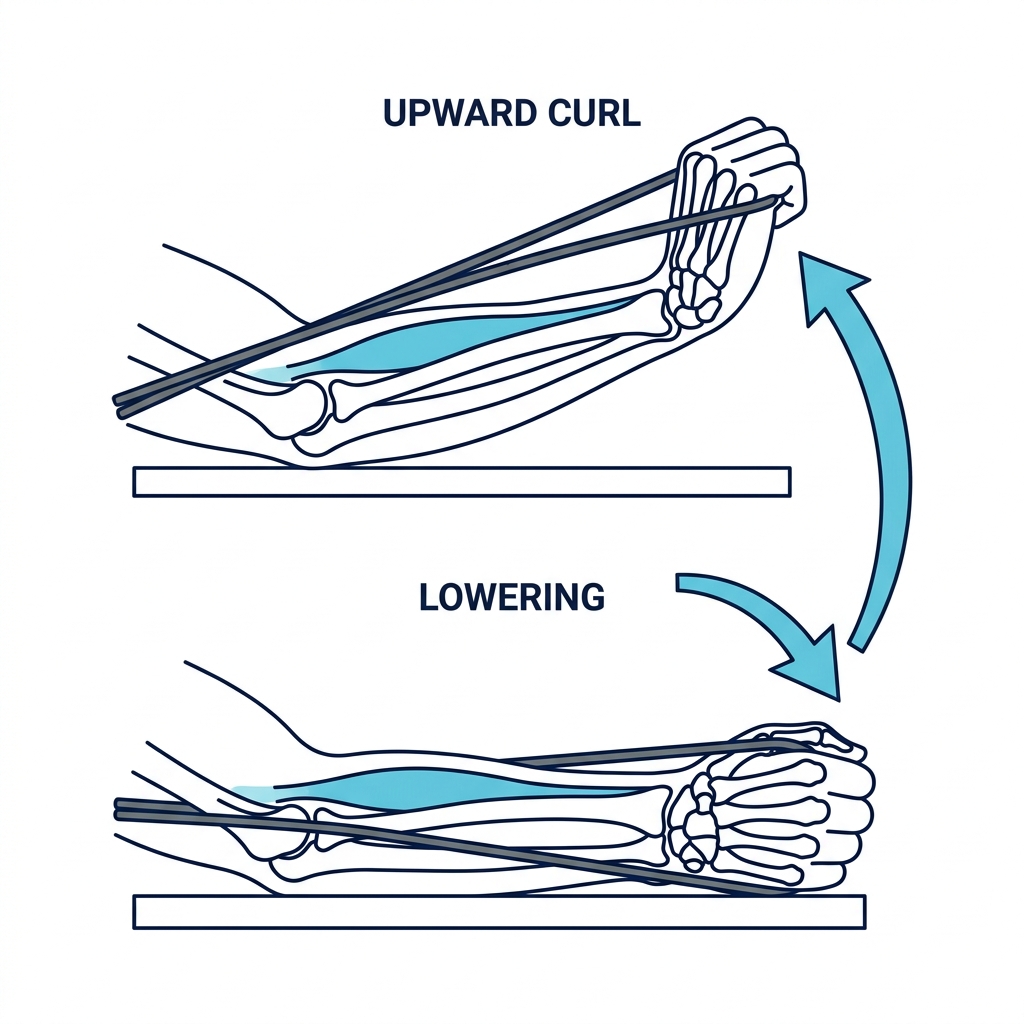
Wrist Extensor Strengthening (Concentric-Eccentric)
- Rest your forearm on a table, palm down, hand off the edge, holding a light dumbbell.
- Curl the wrist upward slowly, then lower it slowly — both directions fully controlled, taking 2 to 3 seconds each way.
- Keep the forearm completely still so motion occurs exclusively at the wrist joint.

Scapular and Postural Setting
- Sit or stand tall and gently draw your shoulder blades down and back, without shrugging up toward your ears.
- Hold for 5 seconds, then relax. Keep your chest open and neck relaxed.
- Build this scapular habit into your daily workstation and desk setup.
3 Targeted Stretches

Extensor Stretch with Elbow Straight
- Straighten the arm out, palm down, elbow locked straight.
- Gently bend the wrist downward with your opposite hand until an easy stretch is felt across the outer forearm.
- Hold for 30 seconds and repeat 2–3 times. Keep it gentle, never sharp.
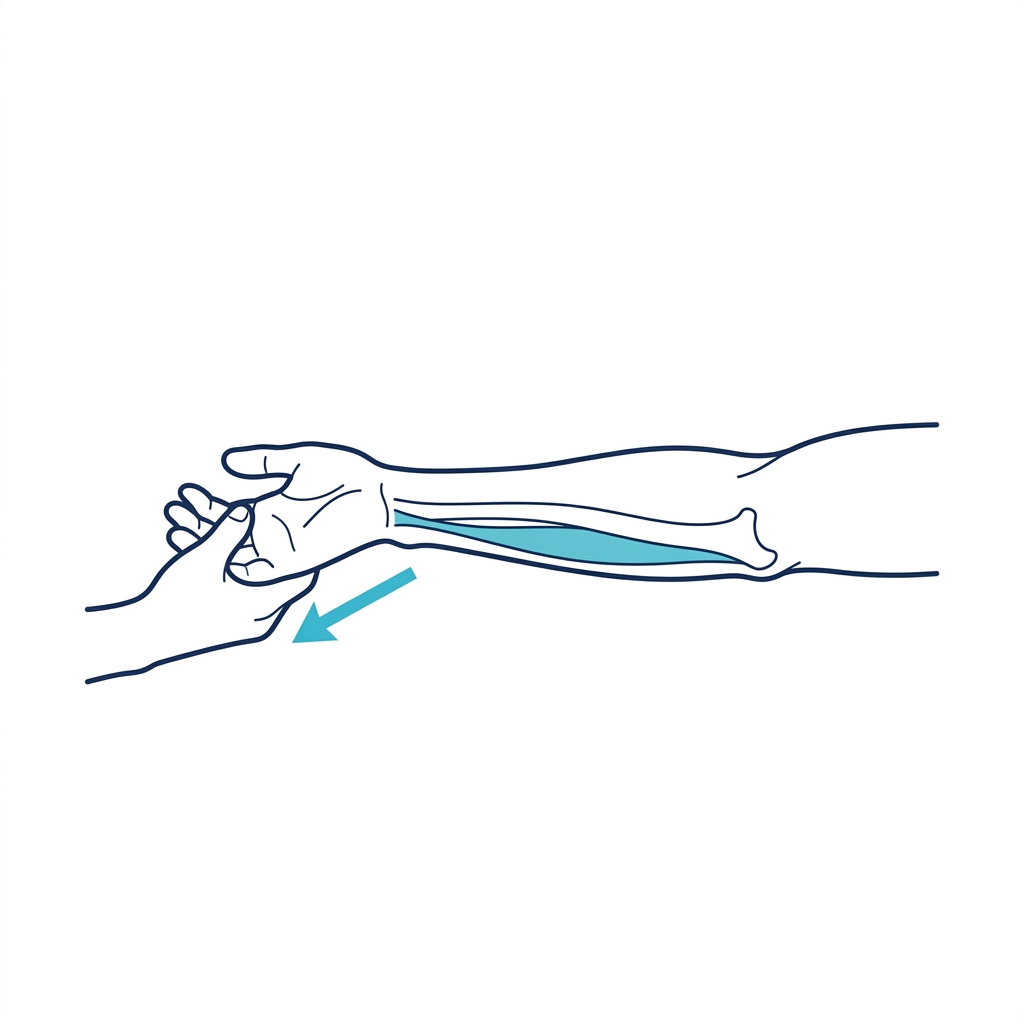
Flexor (Palm-Up) Balancing Stretch
- Straighten the arm out, palm facing up, elbow locked straight.
- With the other hand, gently draw the fingers and wrist downward until you feel an easy stretch along the underside of the forearm.
- Hold for 30 seconds, then release smoothly.

Neck and Upper-Trapezius Stretch
- Sitting tall, let the sore arm rest at your side or anchor the hand under your chair.
- Gently tilt your head toward the opposite shoulder until an easy stretch is felt along the side of the neck.
- Hold for 20 seconds, return slowly, and repeat on the opposite side.
A Note on Counterforce Braces — Use with Caution
The counterforce brace — a strap worn around the upper forearm 1 to 2 inches below the sore elbow — is a popular tool that can take the edge off during aggravating tasks by diffusing tension away from the epicondylar attachment. However, it must be used with real caution.
Important Nerve Safety Caution:
A brace worn too tightly or positioned incorrectly can compress the posterior interosseous nerve (PIN) as it passes through the radial tunnel on the outer forearm, or pinch the ulnar nerve on the inner elbow. This can produce numbness, tingling, or finger drop (weakness extending the fingers or thumb) — a neurological problem far more serious than tendon pain.
- The strap should feel snug but never tight; you must be able to slip a finger under it easily.
- Wear it only during provoking activities — never all day and never while sleeping.
- Position the pad over the fleshy muscle belly, never directly over bone or the inner groove.
- Remove immediately if you experience numbness, tingling, or weakness in your hand or fingers.
When to See an Orthopaedic Specialist
Tennis elbow is largely a success story of conservative care — over 90% of individuals resolve their symptoms through patient eccentric loading, with surgery reserved for the small minority failing 6 to 12 months of therapy. See an orthopaedic surgeon if there is no meaningful progress after 3 to 6 months of diligent exercise; if pain radiates several inches down the forearm (suggesting radial tunnel syndrome rather than isolated epicondylalgia); or if you develop weakness straightening the fingers or thumb. In refractory cases, advanced MRI evaluation, focal shockwave therapy, or minimally invasive common extensor origin (CEO) debridement provide reliable relief.
Dr. Christian Veillette MD, MSc, FRCSC is Division Head of Orthopaedic Surgery at University Health Network (UHN), Associate Professor in the Department of Surgery at the University of Toronto, and an orthopaedic surgeon at the Sprott Department of Surgery and Schroeder Arthritis Institute, Toronto Western Hospital.
Medical Disclaimer: This article is general educational information and not a substitute for individual medical advice. Speak with your doctor or physiotherapist before starting a new exercise program or using an orthopaedic brace.